Predominantly inattentive presentation
Inattentive characteristics are present at the level required for diagnosis, without sufficient hyperactive-impulsive characteristics for the combined presentation.
Understanding ADHD
ADHD (Attention-Deficit/Hyperactivity Disorder) is a neurodevelopmental condition defined by a persistent pattern of inattention and/or hyperactivity-impulsivity that interferes with functioning or development.
ADHD begins during development and can continue into adulthood. How it presents can vary considerably from one person to another and may look very different from the stereotypical image of a hyperactive child.
What is ADHD?
ADHD is a neurodevelopmental condition defined by a persistent pattern of inattention and/or hyperactivity-impulsivity that interferes with functioning or development. It is not a result of low intelligence, a lack of effort or poor self-discipline.
Some people primarily experience inattentive characteristics, some predominantly experience hyperactive and impulsive characteristics, and others meet the criteria for both. Presentation can also change over time.
ADHD is not simply an inability to pay attention
Many people with ADHD can focus deeply on things that are interesting, novel or meaningful. The difficulty may instead involve regulating and directing attention consistently, particularly when a task is less stimulating, demanding, repetitive or difficult to begin.
It’s not simply a lack of attention, but a difference in how attention is regulated.
What can Adult ADHD actually look like?
These are examples, not a diagnostic checklist. ADHD presents differently between individuals, and several of these experiences can occur for reasons other than ADHD. A diagnosis requires assessment of the full diagnostic criteria, developmental history, functional impact and alternative explanations.
The three ADHD presentations
ADHD may present predominantly through inattentive characteristics, predominantly through hyperactive-impulsive characteristics, or through a combination of both. A person's presentation can also change over time.
Inattentive characteristics are present at the level required for diagnosis, without sufficient hyperactive-impulsive characteristics for the combined presentation.
Hyperactive and impulsive characteristics are present at the level required for diagnosis, without sufficient inattentive characteristics for the combined presentation.
Both inattentive and hyperactive-impulsive characteristics are present at the level required for diagnosis.
Executive functioning
People with ADHD may experience difficulties with aspects of executive functioning. These experiences vary between individuals and are not, by themselves, a diagnostic checklist for ADHD.
ADHD beyond childhood
ADHD begins during childhood, although it may not be recognised or diagnosed until adulthood. How it presents can change with age, and the difficulties experienced by an adult may look very different from the stereotypical image of a hyperactive child.
Women & ADHD
ADHD is recognised as being under-recognised in girls and women. They may be less likely to be referred for assessment, may remain undiagnosed, or may first present for help with other difficulties.
Emotional regulation
Some people with ADHD experience intense emotional responses or difficulty regulating emotions. Emotional dysregulation is associated with ADHD, but it is not one of the core DSM-5-TR diagnostic criteria and can occur for many other reasons.
Co-occurring conditions
ADHD can co-occur with other neurodevelopmental and mental-health conditions. This does not mean that every person with ADHD will experience another condition, and similar symptoms can have different causes.
Having ADHD does not establish another diagnosis. Other psychological, developmental and medical conditions can also produce difficulties that resemble aspects of ADHD. This is one reason a comprehensive clinical assessment and differential diagnosis are important.
ADHD + Autism
ADHD and Autism are separate neurodevelopmental conditions with separate diagnostic criteria. Having ADHD does not mean that someone is autistic, and being autistic does not mean that someone has ADHD. Some people independently meet the diagnostic criteria for both.
A person can meet the diagnostic criteria for ADHD without meeting the diagnostic criteria for Autism.
A person can independently meet the diagnostic criteria for both ADHD and Autism.
A person can meet the diagnostic criteria for Autism without meeting the diagnostic criteria for ADHD.
One diagnosis should not be assumed from the other.
Explore Autism & ADHD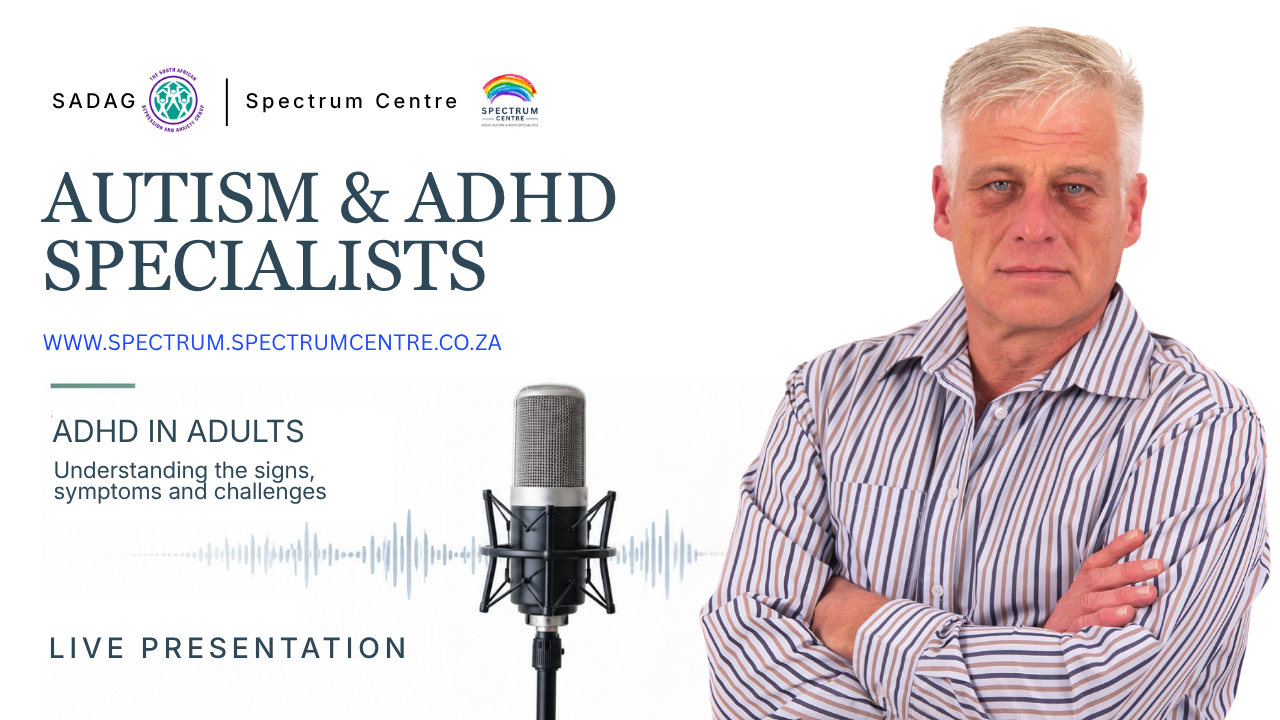
Want to understand adult ADHD in more depth?
In this presentation, Chael Nel explores how ADHD can present in adults, common misconceptions, and some of the experiences that can accompany adult ADHD.
Long-term psychological therapy
Receiving a diagnosis and receiving appropriate support are not the same thing. Psychological therapy can provide space to understand how ADHD affects your particular life, explore difficulties that have developed over time, and work on strategies that fit your needs, values and circumstances.